
"Militants operating out of Pakistan and Afghanistan continue to threaten Afghan stability as well as stoke tensions between Pakistan and India," Gen Votel said.
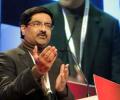
'While the march of globalisation is perhaps inevitable, what is certain is that the world is no longer flat as, the emerging pattern of trade is more regional. 'This new trend of 'slowbalisation' raises some questions that challenge conventional wisdom on how businesses should distribute their capacities,' Birla said.

After years of disappointing growth, the economy and the markets are poised for a breakout, notes Akash Prakash.

'If the almost literally heart-stopping Suez block has any positive outcome, it is to be hoped that it will accelerate the setting up of a fab (perhaps Taiwanese) in India,' asserts Rajeev Srinivasan.

'There is a sense of realism in the Pakistan army that if they needled India during the Ladakh standoff, they would have seen a strong retaliation.' 'Pakistan was hoping that India would come out looking weaker in the region and get embarrassed, but that obviously has not happened.'

The recent report in the New York Times that China had brought India's financial capital - Mumbai - to a halt by hacking the electricity supply grid has not come as a surprise to the CTOs (chief technology officers) and cyber security experts. Indian companies, including critical infrastructure providers such as power grids, ports and radar systems, lack the IT infrastructure to prevent hacking from hostile state actors like China and North Korea, warn security experts. Recently, the United States government warned of yet another breach of critical systems tied to Microsoft Exchange email systems that the company has blamed on China. The breach has impacted thousands of organisations in the US and its impact on India is still unknown.

The agreement would divert China's attention and keep them busy in the Pacific theatre, probably resulting in a reduction in threat perception in our area of interest in the Indian Ocean, notes Commodore Venugopal Menon (retd).

'One out of three phones sold in India is a Xiaomi phone.'

'The hackers' objectives were centred around smearing India's reputation, causing productivity loss, creating operational damage and seeking financial gains.'

In the second of the three part series, C Raja Mohan, Strategic Affairs Editor with the Indian Express, says that as India moved from the expansive internationalist vision of Jawaharlal Nehru to the narrower worldview of the Indira years, the pursuit of 'strategic autonomy' became an important theme in the Indian foreign policy discourse.
C Raja Mohan, Strategic Affairs Editor with the Indian Express, analyses the unfolding geopolitical change in the Indian Ocean and dwells at some length on the challenges that it poses for India's foreign and security policies.

The aircraft was forced to land at Jaipur airfield by air defence aircraft of the IAF, they said.

'COVID-19 will not stop the expansion of China's 'infrastructure power'.'

'President-elect Biden, in particular, has deep knowledge of, and experience with, dealing with India, serving as a custodian and champion of the relationship long before it was fashionable to do so.'

'The sooner Pakistan and India face these geopolitical realities, the better it will be for their own security and prosperity,' observes Ambassador M K Bhadrakumar.
In the last of a three-part series, startegic expert C Raja Mohan says that India needs a new maritime strategy and diplomacy that are at odds with many of its past normative and ideological preferences

The festering dispute over the accession of Jammu and Kashmir stands out as one of the world's most volatile fault lines that divides regions, countries, societies, communities and ethnic groups, notes Mohammad Sayeed Malik, the distinguished commentator on Kashmir affairs, on Sheikh Abdullah's 39th death anniversary.

The world wants to halt climate change, but do it without affecting economic growth and consumption. This fundamental contradiction is the key theme at Davos 2020.

The USS John Paul Jones acted like a dog marking the lamp post, observes Ambassador M K Bhadrakumar.

Prime Minister Narendra Modi on Saturday hard sold his government's reforms spanning from manufacturing to taxation to labour, saying they have changed the world perception about the country from 'why India' to 'why not India' and went on to quote record foreign investment during the pandemic as a testimony to that. Speaking at industry association Assocham's Foundation Week event, Modi also said agriculture reforms brought by his government six months back have started benefiting farmers. The reforms in the last six years have influenced in changing the sentiment of the industry from 'why India' to 'why not India' in investing.

India has much paranoia in India about a new 'Terroristan' coming up between Pakistan and a Taliban-ruled Afghanistan. Pakistan has zero ability economically, diplomatically, geostrategically or militarily to create one. If they try, it will be great for India as they will destroy themselves yet again, asserts Shekhar Gupta.

Considering that Qatar is a trusted ally of Washington for decades, it is expected to be a steady influence on the Taliban leadership, observes Ambassador M K Bhadrakumar.
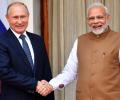
'Washington senses that the anchor sheet of India's strategic autonomy lies in its longstanding partnership with Russia, which remains firm and immutable despite the changes in world politics in the post-Cold War era,' notes Ambassador M K Bhadrakumar.<

The Taliban have the ISIS in its crosshairs. The Taliban has shown the skill to assimilate extremist elements if they are reconcilable as well as the ruthlessness to eliminate troublemakers, observes Ambassador M K Bhadrakumar
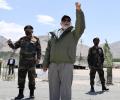
'Breaking down silos and ensuring a more integrated governance process is just as important to performance.' 'It has been a major priority in the last six years, especially in national security,' External Affairs Minister Dr Subrahmanyam Jaishankar points out when delivering the Sardar Patel Memorial Lecture-2020: India and the Post-Covid World.

'The stage is set for increasing tensions in a highly volatile region as crucial as ever from a geopolitical standpoint,' predicts Claude Smadja.

Terming Abdullah as "a very vocal critic" of abrogating Article 370, the J&K administration claimed that his acts squarely fell within the realm of public order as it was "calculated to disturb public peace and tranquility".

The onus today is on China, but it also requires a little diplomatic finesse from India, backed by a modernised armed force, argues BJP MP Subramanian Swamy in this excerpt from his new book, Himalayan Challenge: India, China And The Quest For Peace.

'Analysts see BECA as a 'force multiplier' for India.' 'But China too is known to have such capabilities.' 'The military gap with China will continue to remain a fact of life, BECA notwithstanding,' argues Ambassador M K Bhadrakumar

'Drone warfare has come to stay.' 'India should exploit the expected Reaper acquisition from the US to build an effective counter terror campaign,' argues Group Captain Murli Menon (retd).

'China is constantly probing India's weaknesses.' 'The challenge is to implement a strategy that will allow India to buy time, gather its strength, and eventually counter China,' recommends Harsh V Pant and Vinay Kaura.
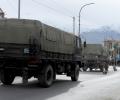
China is in no hurry to disengage at the border and the region and international community is moving on. The spectre of a long haul in Ladakh haunts India, points out Ambassador M K Bhadrakumar.

'The market recovery is fragile,' warns Raamdeo Agrawal, co-founder and joint managing director, Motilal Oswal Financial Services.

India needs to shed its policy of lethargy and inhibitions to engage the Taliban with an intent to maintain its influence in Afghanistan. This would not just put a spanner in Pakistani designs, but also incentivise the Taliban not to be the puppets of GHQ, Rawalpindi, asserts Colonel Nikhil Apte (retd), who served on the Af-Pak desk at the Military Operations Directorate.

'The world needs India because it needs a voice that speaks of peace, non-violence and peaceful coexistence.' 'This vision and voice, this attitude and belief are what India has stood for over the last twenty millennia,' Vice President Venkaiah Naidu tells trainee diplomats.

'China, much more than Pakistan, is a credible potential adversary with the ability to hurt our interests.' 'It must figure higher in our national security concerns,' says Vice Admiral Premvir Das (retd).
Against the backdrop of the standoff between Indian and Chinese troops in eastern Ladakh, the White House press secy said the United States was closely monitoring the current situation and supports its peaceful resolution.

One has to wonder what is so wrong with the European Union.

Sartaj Aziz has blamed India for allegedly "creating hurdles" in the way of process to normalise the relations between the two countries.

Competitive advantage is increasingly transient and companies need strategic and operational agility to operate in this environment of uncertainty.
